

Seumas MacInnes arrived at Cafe Gandolfi in 1983 to peel potatoes and chop red cabbage and carrots. By 1995, he’d been a kitchen-porter, charge hand, manager and co-owner until Cafe Gandolfi’s founder, Iain Mackenzie, passed the flame on. His family background in Barra has informed his approach to food and helped create one of the most loved restaurants in the city.
Cafe Gandolfi now also boasts a bar and a separate neighboring restaurant Gandolfi Fish. They take their cooking seriously here and offer a relaxed haven for long lunches or fun evenings with friends.
Glasgow is enjoying something of a culinary renaissance led by a cadre of young chefs and a taste for quirky, casual dining. All the while, Gandolfi remains one of the city’s culinary touchstones.
We sat down for a cup of tea one morning with Seumas and had a chat about the Gandolfi story, Glasgow restaurants and favourite ingredients.
Gandolfi is one of my favourite places in the Merchant City. I’ve always thought of it as a fixed point in an area that has undergone a lot of changes. What has it been like looking out from here and seeing those changes?
So often when you are so involved in your business and hands on as I am, you don’t really have a chance to look out and notice what others are doing. Of course, it makes sense to lift your head sometimes.
For me, all the competition around me has been good because before when we were the only business here in 1979 into the early 80s, people often thought they wouldn’t get a table here because it was so busy but now people try and if not, they’ll go to somewhere else.
The café opened in 1979 and I got involved in 1983. Even then people thought we were a step too far towards the East. It’s unbelievable now when you think about it. [Laughs]
So this was on the wild border territory of the city centre?
This was, it was a step too far for some people. They would get a taxi down from Central Station thinking they were being brave.
Now, the Merchant City is going from strength to strength. I see lots of new places opening, sadly some closing. It’s much easier to open somewhere than it is to sustain it.
When you first arrived here, you started working in the kitchen didn’t you?
I had studied hotel management and I had got my chef qualifications. I worked in various places but I needed a part-time job. I got a job in the kitchen – they didn’t need me as a head chef, they just needed someone to peel the potatoes and wash the dishes. So I was the Kitchen Porter.
How does someone go from Kitchen Porter to owner?
It didn’t happen overnight, I can assure you. I worked in the kitchen at various levels, then the manager left and I wanted to be the manager. I applied for the job and got it. After managing for six years, Iain Mackenzie [the owner] asked if I would become a junior partner, which of course I said yes to.
Had that been an ambition?
I’ve always wanted this. My parents wanted me to be a lawyer or an accountant or something. I wanted the hospitality industry.
So that was a great opportunity for you, being invited in?
It was. Then Iain just thought “I’ve had enough”. This is a kind of hard job. You’re constantly fire fighting. If you’ve got the mentally to cope with it then it is all well and good. Not everyone has. He wanted out and asked if I would buy him out.
I’ve always been struck by the pictures of the old cafes on the walls here
That was Iain Mackenzie’s work. Remember, we’re called Gandolfi after a camera. That was Iain’s craft, as a photographer.
It’s a rich tradition, the Glasgow café, in all it’s different forms. Do you see that as part of what you do here, that you have a strong sense of place?
I think the fact that people use us in such a casual way – and I mean casual in the nicest possible way, it’s great seeing women come in and they’ll have a bowl of soup, maybe a glass of wine, and sit on their own. That’s a lovely thing that people feel comfortable to come in on their own. They’re a nice informality to this room.
That changes in the evening of course, this room is a bit livelier.
Yes, people use it for lots of different reasons. People come in for a coffee and a chat, tourists, lots of different types of people. We have a lovely repeat custom base which is really important to me.
What was the idea behind opening Gandolfi Fish, and the bar?
The bar just seemed like, well, we had a roof space, we should use it. It’s just a little discrete bar. I think it all appeals to the universal Gandolfi customer but there is maybe a younger audience for Gandolfi Fish.
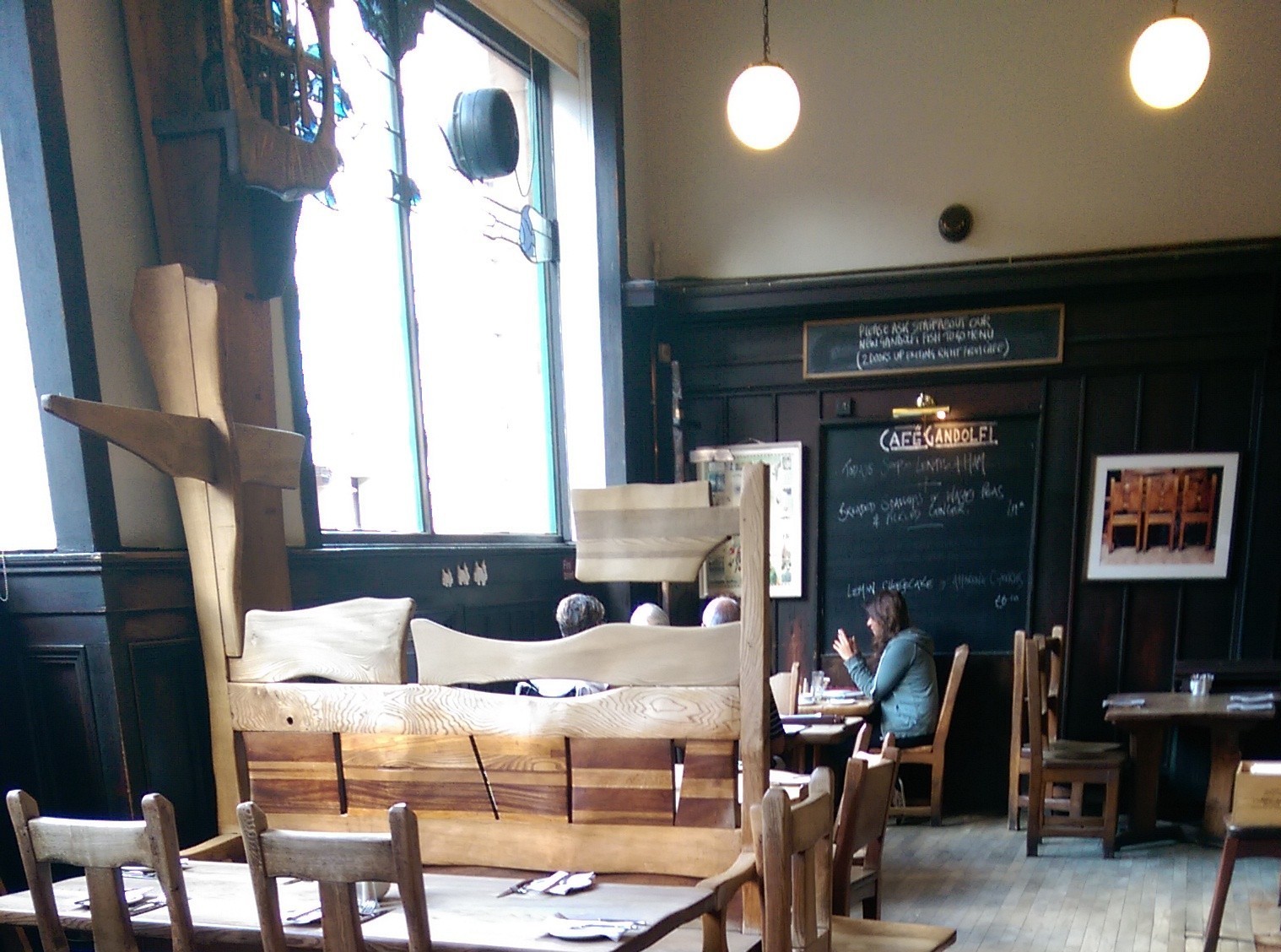
Can you tell me about the look of this room, the furniture is very distinctive.
The furniture was the first commission of a man called Tim Stead. His work is seen in the Museum of Modern Art in Glasgow. He’s thought of as a very important furniture maker, although he considers himself more of a sculptor.
The furniture is from 1979 and Iain knew of Tim’s work because both of them were at art school. So we’re very privileged to have this furniture. When you think of the restaurants that have not been refurbished in 37 years.
I had no idea these were original features. They still look fantastic. That’s a great story. Now, alongside the café, you’ve also had some cookbooks published.
I’ve had two – I always think it’s funny if I’m introduced as author and restaurateur.
And also poster boy for black pudding
[Laughs] The pudding man. The first book was the Gandolfi Cookbook and we self-published that one. The one that was more of a surprise when Birlinn Press asked me if I’d write a book for them and I jokingly said I would do it on black pudding and call it the Stornoway Black Pudding Bible.
In terms of the ingredients that are the core Gandolfi staples, why did black pudding appear on the menu?
Because I come from a culture that makes its own. My mum would make her black pudding and so would my gran. I brought things that we had at home into the restaurant, like the haggis is from Dingwall and that’s the one that my mum would buy. Macleod and Macleod are my favourite black pudding maker and that was because my wife’s mother uses them. When my brother lived in Stornoway, that’s what he used.
I like the idea that ingredients that we do very well in Scotland, like fish and black pudding and haggis, we’re learning to do other things to them than just put them in the fryer.
Absolutely, I think we have more of a pride in our own produce. Haggis, Arbroath smokie, black pudding, our cheeses. And also our raw materials like our game and meat and seafood. We saw the world wanting it and thought, we better start using it. I think all over Scotland, things are much better.
In terms of the Glasgow restaurant scene, over the last couple of years, there have been some new arrivals that have brought a bit of attention to the city as a culinary destination. Then there are restaurants like Gandolfi and The Chip and others that have been doing it for a long time and are examples of what’s possible in Glasgow. Is the city in a good place right now?
I think it is in a really good place. There’s lots of small independent restaurants opening up, especially in Finnieston, and I love the fact that it’s not all chains.
The Finnieston thing must be quite reminiscent of what happened in this area?
Well, not really, it’s not as independent here as it is up there which is a really great thing for the city. I would love that to happen a bit more in the Merchant City. A lot of our bars and restaurants are a bit generic.
That’s another thing that’s happening at the moment – a lot of restaurant brands are deciding they want a landmark spot in Glasgow.
Well there’s only so many burgers that anyone can eat… It doesn’t appeal to me at all, but there’s a young market for that. I don’t really want to go out and eat my food off a bit of greaseproof paper.
Glasgow was overlooked again by the Michelin guide for a star..
Ach, I think that will come. How often do you want to dine at a Michelin standard?
Well, it’s a very exacting standard and not necessarily the type of thing that Glaswegians crave.
I would agree with that. I think a lot of the time you just want the waiter to leave you alone. Just put the bottle on the table, please! I don’t want to constantly be looking for you to top my wine up. I want to do it myself. That kind of service is not what I crave at all.
I like good service. It starts with a smile and then goes on.
It terms of service at Gandolfi, how important to you is it that you are here in the kitchen or on the floor?
I love being here. I spend my time between the three places, Café Gandolfi, Gandolfi Fish and the bar. Today someone has phoned in sick so I’m in the kitchen. I work six days a week, I take a Sunday off and I don’t begrudge one minute of it.
I presume that you’ll have customers that have been coming here for a long time, it might be different generations of a family at this stage.
Oh gosh yes. They come as children, then you see them as adults, then they are bringing their own babies and stuff. It’s wonderful.
What’s next for Gandolfi?
Can I just keep going? Can I just maintain what I’ve got? [Laughs} we have lots of plans at the moment. I’m working with House for an Art Lover, looking at doing a pop-up with them. I work with Harris distillery, just trying to point them in the right direction. The Islands are very important to me. My wife is from Harris and I am from Barra. Their gin is great and their whisky is going to be magic.
Do you have a strong sense of identity as a Glaswegian?
Oh, I’m a Glaswegian. Absolutely. We’re so proud of our city. I love that. When people come as tourist, people want to tell them about their history and want them to have a good experience. We saw that at the Commonwealth Games.
What about the producers that you have a relationship with, who are the folk that allow you to create outstanding dishes?
I love the Fish People. I’ve been with them for 17 or 18 years. It’s not always about price, it’s about service and quality. I always get the best from them. I’ve a great butcher, McCaskie, they are based in Wemyss Bay so I go all the way to Wemyss bay to get my sausages. They are a brilliant family butcher. It’s important, why would you use something in the restaurant that you wouldn’t use at home? You buy the best you can.