

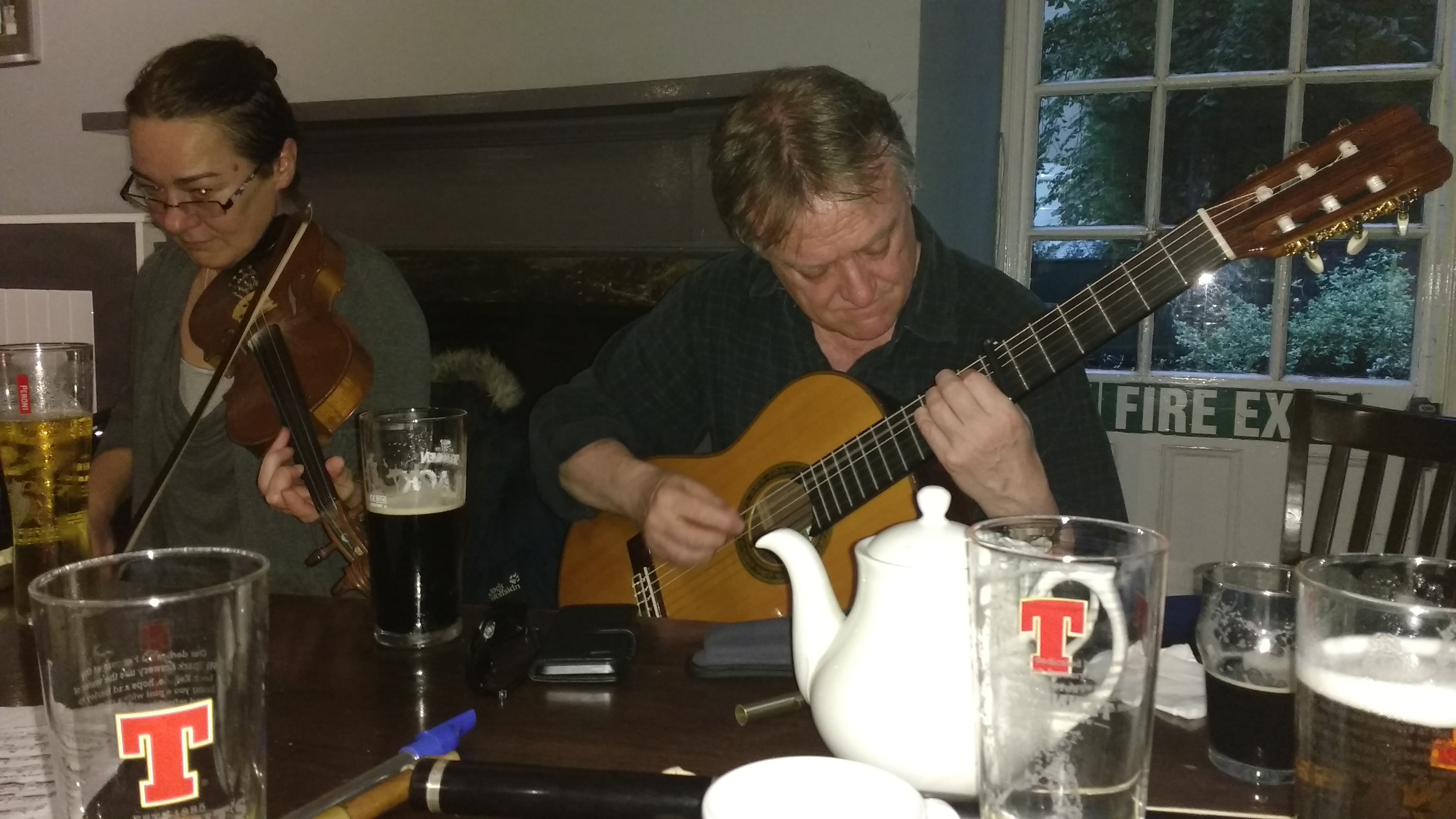
Every Saturday and Wednesday afternoon, musicians trickle into Babbity Bowster, the long-standing pub in Blackfriars Street in the Merchant City. They gather around a table near the fireplace, two of them always sitting on a bench dedicated to Mike Berry, a great Glasgow fiddle player, teacher and session stalwart who died in 2008.
Someone tweaks fiddle strings, someone else assembles the plumbing that makes up a set of Irish pipes, and another clears out a flute with a blast of air. Pints are placed on the table, amidst whistles, bows, mobile phones, tuners. Then someone twiddles a couple notes, a half-remembered tune, the musician next to him picks echoes the phrase, and the music begins.
They play fiddles, flutes, guitars, accordions, tin whistles, concertinas, bagpipes, the Irish drum called the bodhran, and even hammered dulcimers. For three hours, often more, the music is almost continuous, Irish and Scottish dance tunes, jigs, reels, hornpipes, marches, punctuated by the occasional traditional song, which briefly stills the chatter in the pub. People respond to it. Tourists and locals a like fill the pub, swirling around the musicians, the crowd increasing as the tunes stretch into the evening.
The session at Babbity’s, as it’s affectionately called, is the longest running traditional music session in Glasgow. The landlord, Fraser Laurie, bought the place in the early 1980s. It was originally a tobacco merchant’s townhouse, built in the 1790s, but it had fallen on hard times, and by the 1980s, it was a derelict banana shop with no roof. Fraser lovingly refurbished and decorated it, then opened its doors in 1985. The Romanesque columns at the front of the pub remind you of its 18th century roots.
Fraser says, “There is a very strong interest in me in traditional music.” Back when Babbity’s opened, the main session venue in Glasgow was the Victoria Bar (or Vicky Bar, as people called it), which shares a building with the Clutha at Bridgegate, on the Clyde. Everyone in Glasgow played at the Vicky in those days. Fraser, ever a patron of the music, used to go there to listen; at the time, he was managing the Tron Bar on the High Street.
Some of the Vicky Bar regulars, including Jimmy McGuire and John Geoghehan, fiddle and flute/ whistle, respectively, who still play in Babbity’s to this day, used to have tunes in the Tron. When Fraser started Babbity’s in 1985, the session launched on opening day. Jimmy says himself and John were there from that very first session.
The Vicky changed ownership in 2007, ending those Friday night sessions that had been a staple of the Glasgow music scene since the late 1970s. That left Babbity’s as the oldest session in the city. In its early days, it was more spontaneous than it is now, musicians showing up in evenings when it suited them and having tunes until late in the night. A lot of them, Jimmy explains, lived around the Merchant City at that time. But then they started having families, more full time jobs, all those adult things that curtail a wild nightlife. “My wee lassie was born in ’87,” Jimmy says, “I didn’t want to play at night. Fraser asked me in ’88 or ’89, why don’t you come in?” That’s when the Saturday afternoon sessions started as a regular event.
“The Wednesday ones started when we all were retiring,” Jimmy goes on to say. The Wednesday sessions were a quiet affair a couple years ago, but they too are expanding and becoming popular, not just with the old guard retirees who were there from the pub’s early days, but writers like me with an afternoon off, students, and passing tourists, or ‘blow-ins,’ as one-off players are called in traditional music jargon.

The tunes are usually a combination of Scottish and Irish tunes, sometimes with Shetland, Scandinavian, or the odd Breton one thrown in for good measure. Jack Bethel, a hammered dulcimer player who has been attending the session for fifteen years, comments, “There are no rules about what type of tunes to play. It just depends who is in on the day whether it is more Scottish or Irish,” while Craig Crawford, a flute player who travels all the way from Oban, says, “It’s where I can get my Scottish tune fix for the week.” He also appreciates the beer and the food: “Lovely beer, and great Scottish grub too.” (the pub has two or three real ales on draft).
But it’s the people who have made the session work for all these years, and Fraser, who provides a consistent, reliable venue for them to play in. Everyone there agrees that a laidback, congenial atmosphere is the heart of the session, and why it’s been so good all these years. Robert Harvie, a fiddle player who has been going to it for twenty years, says that he started coming to the session when he was taking fiddle classes in Easterhouse with George Jackson, from the band Ossian. “George was telling us to come down. He says, ‘listen and learn,’” Robert reminisces. For months, he went down without his instrument, then gradually developed the confidence and skills to join in. “I like the people here. Good tunes, good vibes.”
Tom McDermott, a concertina player who has been attending the session for six years, agrees with the sentiment. “Courtesy makes it work. Everyone is very nice to each other. I like the people, tunes, and pub. It’s a family thing, my son and brother come here.” Tom’s son, Neil, is a fiddle player, who usually arrives at the Wednesday session after he finishes work at Glasgow University, and he regularly attends the Saturday one. Neil says, “I like it because of the venue. I love that pub for reasons I’m not totally clear on.”
The session somehow attains that difficult balance between satisfying experienced players, who want decent tunes, but also encouraging the less experienced ones and enabling them to feel welcome. David Finlay, an uilleann (or Irish) piper and retired veterinarian who has been playing this difficult instrument for about seven years, says, “I was just learning when I started [coming to Babbity’s]. It’s an environment where I feel I can progress, learning reasonably comfortably. It’s about getting to know people and being accepted.”
It’s a session you can keep going back to; not a ‘beginners’ session,’ but no one has anything to prove, as Stewart McIsaac, a guitar and bouzouki player, points out, which affects a warm, pleasant ambience. I had only been playing the uilleann pipes for two years when I made my first appearance at Babbity’s, and needless to say, I wasn’t very good. I nonetheless felt welcome at the pub. Almost ten years later, and far more capable at the instrument, I still feel welcome.
People from all over the world have had similar experiences. Arlene Patterson, a fiddle player from Longmont, Colorado in the United States, says she played with the group in the 70s, finding them to be “fun loving, and generous in [their] sharing of the music, all of which helped form me as a “lifer” for fiddle playing.” In 2012, Arlene returned to Scotland, once again playing tunes with the Babbity’s crowd: “I found the Babbity session to be every bit as welcoming and friendly as it was in the 70’s. I even encountered some of the same folks from those early sessions. Like me, their life’s path had wandered back to Blackfriar’s Street on a Wednesday and Saturday afternoon. What a tradition!”
“There’s a core element who have been with me all these years,” Fraser reflects, looking at the session. “It’s formed friendships and grown roots.” In the right corner of Glasgow, with a pub landlord who loves the music and welcomes the players, it thrives.