

Maxi Jazz was an enigmatic and committed frontman with Faithless. His performances at T in the Park and the Barrowlands, alongside venues all over the globe in the last 20 years, have established his voice in the pantheon of British musicians. He is returning to Glasgow, but the Buddhist rapper has found a new form. This time he will play Oran Mor with his guitar band, performing with some of his friends and favourite musicians.
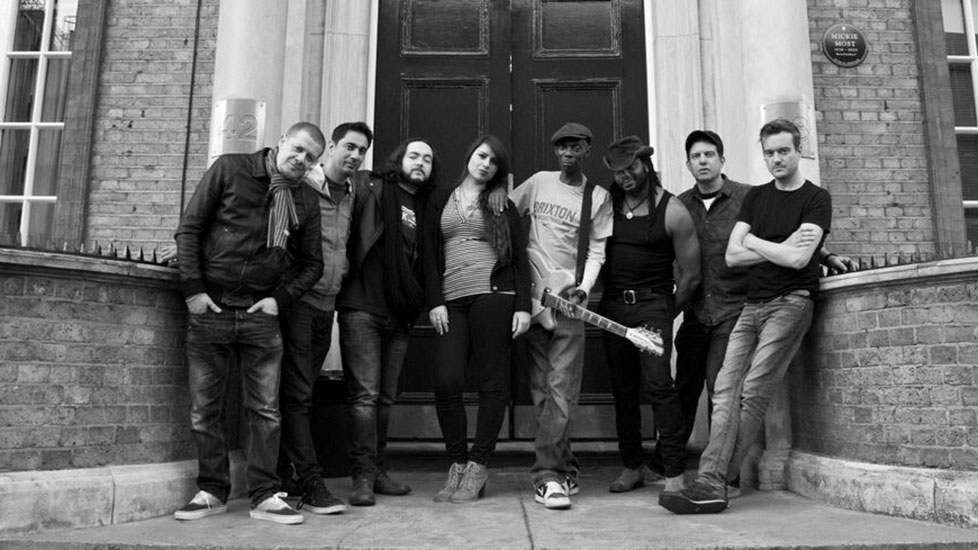
Maxi Jazz and The E-Type Boys promise melodic funk and blues, mixed with reggae beats, dub baselines, and Jamaican melodies, with insightful lyrics delivered by that distinctive voice. If you have a ticket for the gig on 7th December then you are in for a treat.
The night before he set off on a UK tour, Glasgowist spoke to Maxi Jazz about his new album, Simple.. Not Easy, and what comes next.
So, it seems we’ve caught you in the midst of rehearsals.
Yeah, just rehearsing right now, we’re playing in Ronnie’s tomorrow night.
Have you played Ronnie Scott’s before?
I have actually, in 1995. I was MCing with Jason Novello’s jazz band. We did a five night residency, Monday to Friday in Ronnie’s, as a straight up jazz band with a rapper and a singer. I have to say, in my wildest imaginings, I never envisaged returning 21 years later with my own band, playing my own songs and singing.
Where did this idea to form a band and pick up a guitar come from?
Well, I wrote my first guitar song in 2005 in Jamaica. I thought “that’s a good song, I like that”. I didn’t write another one for three years. Then suddenly I had two songs, and I thought I’d write some more, so I wrote another three. Then came 2010/11 and I’m about to step away from Faithless and do some more music. Ordinarily I would just do a hip hop record, because that’s what I do, that’s what I had been doing. But then I had these guitar songs so I called up my keyboard player. I played him the songs, he thought they were really good so I said “okay, let’s get a band together”.
It’s a completely fresh thing. I’ve been rapping over beats for thirty odd years. Obviously though I’ve been listening to punk music and blues music and reggae music for my entire life. [Chuckles] The idea, at my age and with my background I would be fronting a guitar band is kind of crazy but it feels really good.
Is part of the impetus for doing this the fact that you know a lot of musicians from over the years and this is a chance to get them together and have some fun?
Exactly, the first people I called for the band – keyboard player, percussionist, bassist – I’ve been playing with them since the early 90s, late 80s for some of them. A hell of a long time. Then the people who got introduced into the band were good friends of those friends of mine. The atmosphere in the band was immediately familiar, it’s like a family, we miss each other if its been too long.
You’re a lyricist and that’s an important element of all the types of music your have been involved in. Electronic music seems to be in a bit of a space at the moment where the more thoughtful songs have been pushed to the side by those who just want to drop the bass. I wonder if a guitar band right now gives you a better platform for your writing than if you were to walk out on stage with a mic and a turntable.
To a degree, I think you are right. With Faithless though, I have to say, right at the beginning before we were even thinking about going out live, we talked about whether we wanted to put it all on tape and just have a couple of keyboards. We decided then it had to be a band. It has got to be a performance.
I think this might have quite a bit to do with Faithless’ longevity. I think, quite a few people, even when we were eight years into it, would turn up at a Faithless concert expecting a couple of guys, a bank of computers and a light show. When they turned up and there was pretty much a football team walking on stage with guitars and sitting down behind drums they thought “wow”. There’s nothing more exciting than seeing a good drummer do his thing man. I don’t care what else you like to watch, that is something else. For me, whether we were doing hip hop beats or house beats or blues music from the seventies, I always wanted to have a band. It sounds different every night.
You are coming to Glasgow on 7th December. I know a lot of places will say this but I always thought Glasgow had a special connection with Faithless. The crowd really responded to your music. What are your memories of playing here?
The crowd really did respond to us. I remember doing Barrowlands. It was just amazing warmth. There was an immediate giving. Scottish people do that. The first time I went to Scotland, I went to a pub in Dundee. I was a bit trepidatious because, you know it was a bit of a situation. When I went in they asked me where I was from, I said London, they said “want a drink?” [Maxi shouts this in a passable Scottish accent], next thing you know I’ve made half a dozen mates and I’ve only been in the place ten minutes.
Lyrically, I’ve always been about empowering people. That vibe that there’s no difference between me and the audience. There’s no reason to look up to me, look up to yourselves. They are the important ones. Let’s say I’m Miles Davis/Jimi Hendrix/Herbie Hancock all rolled into one guy with the best band that’s ever been and we book a gig at the SECC and half a dozen people turn up. How important does that make me? When 12,000 people rock up to the SECC to watch your band, they are the important ones, without them there is no gig. The audience are the important ones and I do value them and I’m grateful for their presence.
When I think back, watching your shows, there’s always a back-and-forth, the audience are participating. Is it easier to get that connection in a smaller venue with a band behind you than when you are leading a vast crowd at a festival.
I’m not sure to be honest with you… It’s the first time I’ve had to think about it, and having given it some thought, I don’t know if there is a difference. It’s the quality of your voice that makes all the difference.
If you are calling your daughter who is now living in Sydney, thousands of miles away, and you’ve got this crackly phone line and she goes “alright dad?” and the first thing you go is “what’s the matter?” Everything that’s in your life is in your eyes, everything that’s in your soul is in your face. In the same way, everything that’s in your life is in your voice.
If you are rapping to people or singing to people or talking to your girlfriend, if you are sincere then it is audible. It’s really quite obvious. People get it. So if you are genuinely grateful for a crowd coming out then they’ll come away feeling better about yourself.
It’s quite often that you go to a gig and the superstar isn’t paying attention to you, he’s just doing his show and then he’ll disappear to his hotel. I’ve had that myself, in an audience watching an artist. I remember thinking that’s not how I’m going to do it, I’m going to connect with people, in between songs and during.
Are you looking to release more albums now – is the idea to be in front of a live audience or do you want to be back in a recording studio?
Me and studios don’t really get on. I find them very stressful places. You might do a gig and not play very well but you have another one the next night. But when you finish an album that’s you for the rest of your life! I mean, making records is great but playing live is always the essence for me and the band are brilliant live, very powerful, melodic, funky, tuneful. Everything you could imagine.
When we go out live, I should be more nervous than what I am. I know if I have a bad night, they’ll carry me and it will be fine.
Is the writing process different with the band?
The writing process I hope will evolve. It started off with ten songs, demos. I have a studio in my mum’s house in Jamaica and that’s where I got all the songs together, wrote the guitar parts, put the drum parts on. I came back, played them to the guys that turned out to be my band. I wanted them to know it was not set on stone, I gave them a bassline that did work but if they had something better then play it. I’m not too much of a taskmaster when it comes to being a bandleader.
So you are not going to do the James Brown thing of fining band members if they miss a note?
[Laughs] Ah well, I will do that for fun, I’ll tell them they can’t come in to my band wearing a shirt like that and say they are fined £20 but they usually just look at me and laugh. Although they usually come back the next day with a better shirt.
Tell us about the music for this show at Oran Mor?
Well there’s the ten songs we’ve got on the album, but we’ve got another seven that I’ve written over the last couple of months. We’ve an hour and a half worth of music already and that’s what we’ll be playing when we get to Oran Mor.
Is it more fun at this stage, I mean you’ve already sold 15 million records…
Way more fun
In a way you know people who come along will understand an element of your music at least.
I’m hoping that element is what brings them to the party in the first place. That’s what will make them leave their warm house on a December night because they think “oh yeah, I know that Maxi Jazz, he’s quite good, I’m going to check out his new band”. Of course, the music will be a lot different, but the vibe? Probably not that different. I want to put over the same feeling, just in a different musical context.