

The Best of Glasgow is a new book celebrating people and places in the city with neighbourhood profiles, recommendations for things to do, alongside stories from independent shops, creative businesses, musicians and artists. It includes a chapter featuring recipes from top local restaurants including Ubiquitous Chip, The Gannet, La Lanterna and Julie’s Kopitiam.
BUY THE BOOK: THE BEST OF GLASGOW CITY GUIDE & COOKBOOK
The city guide features personal reflections on local life from personalities including Alex Kapranos of Franz Ferdinand, Clare Grogan, Harri from Sub Club, Gavin Mitchell, Pat Kane, Jean Johansson and Lynn Ferguson.
Here, in an interview taken from the book, PJ Moore reflects on a musical and personal connection to Glasgow.
The Source of The Blue Nile
PJ Moore is very easy to talk to. We are gabbing away while wandering across from the Kelvingrove to the nearby Ronzio cafe to pick up takeaway teas. I’ve never met him before but we have a friend in common – Irish journalist Ken Sweeney. Ken made a radio documentary, In Search of The Blue Nile, about the musical journey of PJ, Robert Bell and Paul Buchanan. The recording was inspired by a trip Ken made to Glasgow, where he was keen to explore a cityscape that he had imagined through the albums he had listened to while growing up.
He wanted to see the places connected to the music. The show was broadcast on RTE Radio, found an audience around the world and was then picked up by BBC Radio Scotland. If you want to hear the story of the band in their own words, you can find a link to the programme here.
PJ and I take a walk back and sit on the steps of the museum. The tall tenements of Argyle Street and the turrets of Kelvin Hall look vivid in the bright afternoon sunshine. Skateboarders are improvising a circuit in the garden and you can see activity along the mini-canyon of Regent Moray Street.
I mention the documentary and the connection Ken made with Glasgow through music. At times, The Blue Nile’s songs can seem a bit too ethereal to be written about Sauchiehall Street or Byres Road in the 1980s, yet Tinseltown in the Rain is about us: “It’s there to be immutable. Tinseltown will never change. I mean the structure of the song, not the poetry. It’s written in stone.”

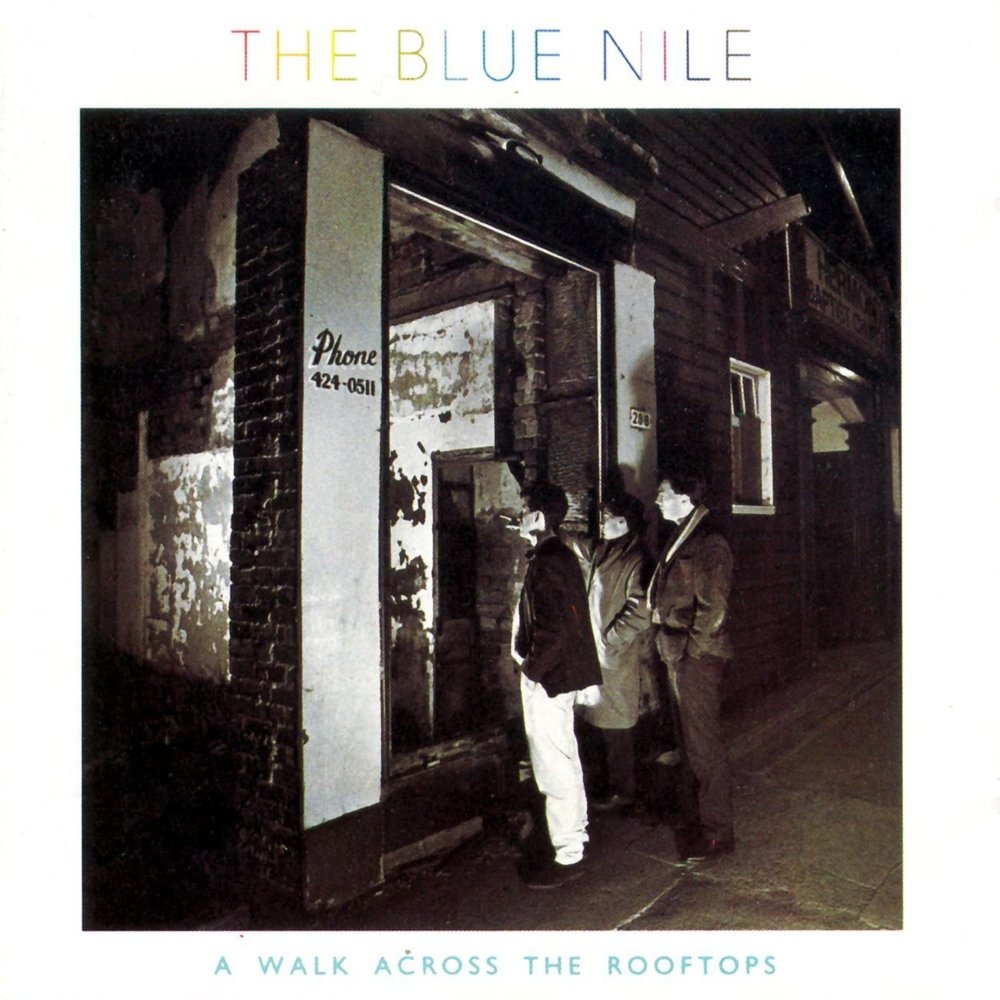
PJ thinks their debut,1984’s A Walk Across the Rooftops, has the most Glasgow in it: “The second record (Hats) has more of actual America in it because by then we’d had a short US promotional visit for Rooftops. The first record’s a naive imagining of Glasgow as an American city and it’s vertical and black and white. Hats is technicolour and more horizontal, but the first one is a fearless leap into the dark, and I love it for that.”
This makes me think about the point when Glasgow moved from a sepia tone, post-industrial city into a brighter modern era as a place for artists and musicians to find their voice.
Before I get lost in metaphors, PJ continues: “We cut off London when we were making the records, it was all independent. The music doesn’t sound like it was made using lo-fi equipment. It’s funny. People talk about polish and smoothness and beauty but I was working as a waiter at the time, we were borrowing synths and the box that I used to interface with the studio, that enabled us to take the first step, cost five pounds.
The European City of Culture year in 1990 was a breakthrough in how Glasgow perceived itself. The Blue Nile had toured America, were back home and the Royal Concert Hall was due to open so they found themselves being asked to play the first concert at the new venue – “but by then Glasgow was already a hotspot for pop, I’ll give you my theory on that if you want?”. I do.
“Well in a place like London. The size of it, it’s hard for people to find the scene, you’d have a few venues for punk, whatever’s happening, they’re there. Good bands and bad ones. Then the New Romantics had places, Boy George at the Blitz Club, Spandau Ballet. But in the absence of that, everyone in London’s just walking around going, “Anybody know a bass player and what kind of bassline should he play anyway?” And it was at that point these A&R guys with their bomber jackets and their attache cases started jumping on the shuttle and coming to Manchester and Glasgow, where they could at least find something.”
I ask PJ where he was waitering in the early days of the band: “Nico’s, Rock Garden. The Ultratheque. It was a great laugh, man. Nico’s was set up as a cocktail bar and art students loved going there, but what they didn’t like to do was spend money on Harvey Wallbangers or Brandy Alexander or whatever passed for class at the time. But you could get a coffee or a beer, and that was a first.
“These places were important for cultural exchange too. It’s where you could go in and meet someone with a funny haircut and you might end up getting a gig out of it.”
At the same time he was running a rehearsal studio “below a very dodgy second-hand shop at The Barras.” Things changed when “we saw a chance, the idea to send messages from here in music, realistically.”
PJ recently made a downloadable walking tour that took in some of the landmarks associated with the band. The artwork for A Walk Across the Rooftops is a photograph of the trio taken on Cathcart Road, but the record was made in a flat in Otago Street: “the building was like a member of the band”.
Then there was a one-bedroom bedsit on Buckingham Terrace: “It came to me through a friend who knew I was looking for a place to stay in Glasgow. I was renting in Edinburgh – Paul visited once and we did Late Night Train – but it was time to get out of there. I moved in, we’d meet, tape recorder in the middle of the room, watching the traffic pass: Headlights on the Parade. We made half of Hats like that. We’d take a break and go a walk to the Cul de Sac bar on Ashton Lane”.
We talk more about the sense of place in the music. This side of town is where the band met and it’s the strongest connection: “The West End’s almost a city on its own. We were all from the Northside, but really the uni brings you here, even if you’re back staying with your maw, you’re heading for Byres Road.”
But are we listening to a more cinematic version of the city than where they were living? “We always felt American. We’re closer there in terms of the look of the city and everyone grew up watching American movies four times a week when they were kids. We were just applying that dream for ourselves more than anybody else. No one looked at Hope Street and said it was like Madison Avenue, right? There was something in those vistas for me, I’ve got notebooks with me trying to draw a big long street with exactly that kind of vibe, that’s Easter Parade. The Glasgow you see now, it isn’t the Glasgow that was there when we were writing the songs. It never existed. It was part Chicago, part New York, part Brigadoon.”
The Best of Glasgow is published by Glasgowist, with support from The Herald and The Glenlivet Single Malt Whisky.
Support independent local publishing – buy Glasgowist a coffee.
 Buy me a coffee