

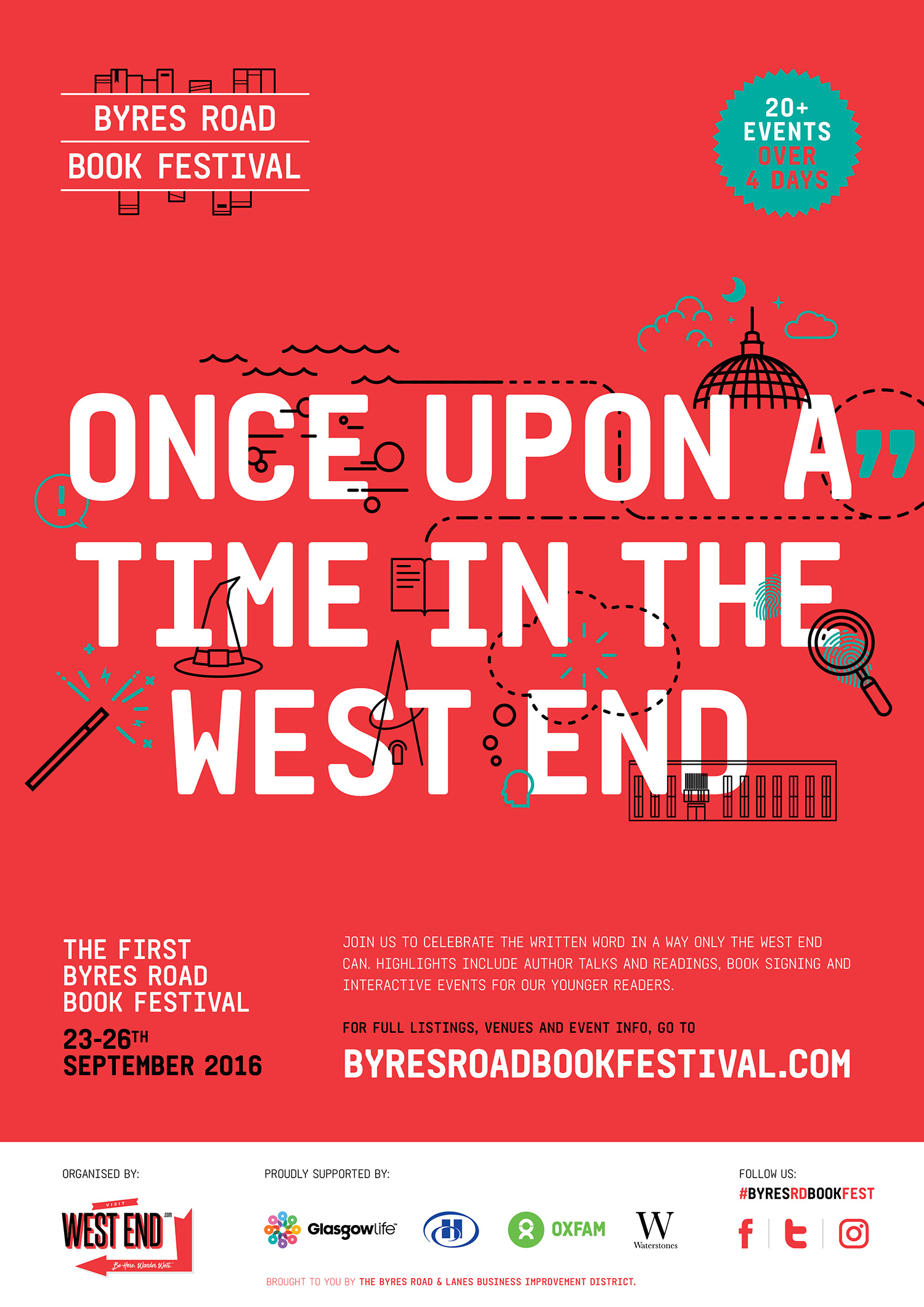
The inaugural Byres Road Book Festival arrives this September weekend with a celebration of the written word and a plethora of award-winning authors and innovative events. Highlights include Graham Macrae Burnet and Christopher Brookmyre, alongside more than 20 top writers for four days of talks and readings, slam poetry, book signings and interactive events for younger readers.
United by a love of books, the top of Byres Roads will be transformed into a book hub with Waterstones, Hillhead library and the Oxfam bookshop hosting a jam-packed program.
Douglas Skelton is a former journalist, investigator, wine waiter, taxi driver, bank clerk and shelf-stacker. He began his newspaper career advertising sales with the West End News, then moved to journalism under its successor, the West End Times, and later the Glasgow Guardian.
He wrote eleven true crime and Scottish criminal history titles before moving to fiction in 2013 with ‘Blood City’, the first of four thrillers featuring Glasgow hard-man-with-a-heart Davie McCall. The fourth, ‘Open Wounds’, was nominated for the 2016 McIlvanney Scottish Crime Book of the Year Award. His most recent book is ‘The Dead Don’t Boogie’, introducing off-beat hero Dominic Queste.
He takes part in a discussion at the festival on Friday. Glasgowist had some questions first.
What started you down the road to writing your first book?
The very first book was a true crime book back in 1992. I’d written a series of true crime features for the Evening Times, and the features editor, Russell Kyle, suggested I put some of these things together as a book. I added a few more pieces and it was accepted by the publisher, Mainstream. It was really quite as simple as that, which was quite astonishing for me. You hear all these stories about how hard it is to get a book published. Then, there it was, the first one I ever submitted was accepted.
Moving forward then into novel writing, was that when you realised you were going to be an author?
That was a harder process. It’s really what I wanted to do all along, even when I was doing the ‘true crime’ books. I always approached the subjects from the perspective of a populist story-teller. I was thinking about how to tell the story, are there any surprises. It was taking a novelisation approach, which is one of the reasons I stopped, I realised I was turning people’s lives into entertainment and I started to feel guilty.
These days, if someone has a story to tell, there is a lot of ways they can do that, across different platforms and in different formats. Do you think it’s more difficult now to get a novel published?
It’s just as difficult to get it published in the traditional sense. But, if you want to write then you can do almost anything. Lots of people self-publish with kindle or ebooks. You can actually just go ahead and do it yourself. If you really have this desire to get your story out there and you can’t get any response from a traditional publisher.
That approach can also be a route to a traditional publisher – James Oswald being the greatest example. He self-published and then got picked up with a big publishing deal from Penguin. There are different routes now.
In terms of the Glasgow writing scene, is it still a fairly fertile landscape in terms of people writing stories about the city?
It’s a small scene compared to the likes of London. There’s the old line [from the narrator of the US TV show] “there are eight million stories in the naked city”, well, there are so many things that could be told about Glasgow. We wouldn’t be asking this story if we were talking about London or New York but people look to Glasgow or Edinburgh and ask whether we are reaching saturation point. I think there’s room as long as people can come up with decent stories, decent characters and decent dialogue.
When you think about the the Tartan Noir form of crime fiction, where is that at the moment? Are there still a lot of those stories to tell?
I think people are breaking new ground all the time with it. Tartan Noir is just a label. It’s not even a genre. So as long as people come up with fresh approaches to stories then it will remain fresh.
Well, I think the thing about Tartan Noir as a label, in terms of Glasgow literature, there’s almost a shared universe, an idea of the city that is inhabited by lots of different characters from different authors. I think its something that people recognise across different books.
Yes, certainly people from Glasgow can identify it. Glaswegians seem to like the idea if you set something in their street. It seems to appeal to them. I’m not sure what the city fathers would think of it but I think its good for the city.
Glasgow has changed but a lot of its enduring problems remain so it important to acknowledge both I think.
A lot of what Glasgow has faced, and is facing, has been faced, and is facing, every major city in Britain. Glasgow has this bad reputation, and we kind of like that. Glaswegians’ take a secret enjoyment that we have this tough reputation, but we’re no worse than anywhere else. Manchester, Liverpool, Leeds have there problems. Edinburgh. It’s the same problems, its drugs, deprivation, poverty. The violence is there, it’s part of human nature, and it always will be I think.
As a crime writer, are you having to adjust to modern trends now. Like, do your Glasgow hardmen characters now arrange a meet at a hipster craft beer hall or trade barbs in a bistro over a cappuccino?
*bursts into laughter* It’s a common complaint from crime writers, the changes in the modern world. Things like the fact that everyone has a mobile phone and the advances in DNA evidence and crime scene forensics. It can be a bit of a pain in the backside. A lot of writers are concerned with Police Scotland and the doing-away-with the old police authorities. But imagination overcomes it. As for any of my characters going to a trendy craft beer hall, I can’t see it, I don’t think so.
The Byres Road Book Festival is this weekend and you are taking part. Are book festivals in general part of the job for an author wanting to promote their books and interact with readers?
You have to do that nowadays and I really like doing them, they’re great. I am actually a really shy person, I always enjoy being in front of an audience, when you have to entertain, but the growth of these festivals and the chance to talk directly to readers is wonderful. They tell you they like that one, but the didn’t like that one and its good to hear that feedback. I’m really glad to see there is one on Byres Road. Byres Road has that cache. Its good to see they have their own dedicated book festival.
What about the challenges of telling local stories. Is there a temptation to think about taking a character and transplanting them to America, or Russia or giving them a French accent, as a way to sell more books?
There’s still a place for local stories. That doesn’t mean you can’t extend your horizons. You can take a long-term character out of their comfort zone, that’s something that always appeals. It add a new dynamic.
I’ll give you an example: Craig Robertson, who writes an incredibly successful serious of books set in Glasgow. He wrote The Last Refuge that was set in the Faroe Islands. It was absolutely terrific. He just thought “right, I’ll flex my writing muscles here” and he rose to the challenge.
I’d like to go outwith of Glasgow and I will someday, but just at the moment, that’s what I’m doing. If I continue with a new series of books, called the Great Western series, I’ve plans to take him out of the country, but at the moment it’s all Glasgow based, Scotland based.
I was reading an article in the New York Times recently about the fact that the internet has not killed off the printed book. Sales of books are stronger than they have ever been. Why has that medium not gone the way of the tape cassette, why do printed books still sell?
I can only give you my personal feelings. I like reading a printed book, because I don’t want to be sitting reading a book on a screen that I’ve been looking at for work all day. Last thing I want to be doing at night is sitting with a screen in front of me. I’ve nothing against kindles and I can understand the attraction. I’m glad people use them because it’s actually opening up more people to reading.
The demise of the book has been greatly exaggerated, to paraphrase Mark Twain. I think we need both the digital and printed market.
Go to the bookshop and you can browse and dip into books before you buy. It’s difficult to do that online, you have to know more or less what you are looking for online. If you go into the bookshop, you can read a bit, find another one. It might be a title attracts you or suddenly a cover illustration attracts you. You can also go to a member of staff and ask them about it. It’s a whole personal experience.
More than 20 top fiction writers are announced on the lineup for the inaugural Byres Road Book Festival – a new imaginative four-day literature showcase set in the leafy West End from Friday, September 23rd to Monday, September 26th.
[…] From Glasgow — Interview: Douglas Skelton on Crime, Fiction, and Byres Road […]